SYSTEM DESIGN:Lesson 20: Scaling Feeds Past the Celebrity Problem
Mastering lesson 20: scaling feeds past the celebrity problem concepts and implementation.
50 million people, one Kohli tweet
Lesson 19 gave you push vs pull. Now scale it. IPL Super Over ends. Virat Kohli posts a two-word tweet. Sixty million accounts follow him. Your fan-out worker starts writing to sixty million Redis lists. The queue depth graph looks like a cliff. Meanwhile, forty-nine million normal users are opening their feeds — each expecting results in under 200 ms.
This chapter: hybrid fan-out, Redis feed cache, ranking pipeline, napkin math for 50M DAU, and the pushback interviewers throw when you say "just cache it."

Celebrity tweet fan-out to millions of followers
Two words from Kohli. Sixty million Redis writes. Good luck.
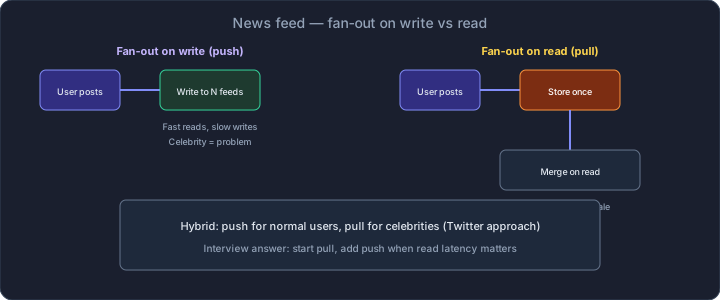
Fan-out on write vs fan-out on read
Push for your college friend. Pull for Kohli. Hybrid is not cheating — it is the product.
Napkin math — 50M DAU
State these numbers before drawing boxes.
Assumptions:
- 50M daily active users
- Each user opens feed 30× per day (commute, lunch, IPL breaks, bedtime)
- Each user posts 2 tweets per day on average (power law: most post 0, some post 50)
- Average following count: 200 accounts
- Celebrity threshold: 10,000 followers → switch to pull
Reads (feed opens):
50M users × 30 feed opens / 86,400 sec ≈ 17,400 reads/sec average
Peak (3× evening + IPL): ~52,000 reads/sec
Writes (new tweets):
50M × 2 posts / 86,400 sec ≈ 1,160 writes/sec average
Peak (3×): ~3,500 writes/sec
Read-to-write ratio: ~15:1 on feed opens alone. Add profile views, likes — easily 30:1 or higher. Optimize the read path first.
Fan-out writes (push path only):
Average user: 200 followers → 200 cache writes per tweet
1,160 tweets/sec × 200 ≈ 232,000 Redis writes/sec (distributed across workers)
Kohli tweet: 60M writes → async queue, minutes to complete — NOT synchronous
The celebrity tweet is an outlier event, not steady-state QPS. Design for steady-state; isolate outliers with hybrid fan-out.
Hybrid fan-out architecture
On post by user U:
  if U.follower_count < CELEBRITY_THRESHOLD:
    async push tweet_id to each follower's Redis feed (ZSET)
  else:
    insert tweet only — followers merge at read time

On feed read by user V:
  1. Fetch pre-built feed from Redis (pushed tweets)
  2. Fetch recent tweets from celebrity accounts V follows (pull)
  3. Merge, rank, return top N
Threshold tuning: 10k is a common interview number. Production teams A/B test it. Too low → too many pull merges on read. Too high → fan-out workers drown.
CELEBRITY_THRESHOLD = 10_000

def on_new_tweet(tweet: Tweet):
    db.insert(tweet)
    follower_count = db.count_followers(tweet.author_id)
    if follower_count < CELEBRITY_THRESHOLD:
        queue.publish("fanout", { "tweet_id": tweet.id, "author_id": tweet.author_id })
    # celebrities: no fan-out job

def get_feed(user_id: int, limit: int) -> list[Tweet]:
  pushed = redis.zrevrange(f"feed:{user_id}", 0, limit * 2)
  celeb_ids = db.get_celebrity_following(user_id)  # follows with >10k followers
  pulled = db.get_recent_tweets(celeb_ids, limit=limit)
  merged = merge_and_rank(pushed, pulled)
  return hydrate(merged[:limit])
Redis feed cache
Pre-built feeds live in Redis sorted sets — score = timestamp or tweet_id for ordering.
Key:   feed:{user_id}
Type:  ZSET
Score: tweet created_at (unix ms)
Member: tweet_id
Fan-out worker:
def fanout_worker(tweet_id: int, author_id: int):
    followers = db.get_followers(author_id)  # paginate in chunks of 1000
    score = tweet.created_at.timestamp()
    pipe = redis.pipeline()
    for fid in followers:
        key = f"feed:{fid}"
        pipe.zadd(key, {tweet_id: score})
        pipe.zremrangebyrank(key, 0, -501)  # cap at 500 tweets
    pipe.execute()
Cap feed depth at 500–1000 tweets. Older posts fall off — user scrolls to "load more" which hits DB for archive.
Redis cluster shards by user_id — each user's feed key lands on one node. This is a natural key-value workload (Lesson 11, Lesson 12).
Ranking and reranking pipeline
Chronological feed is the MVP. Real X/Instagram feeds are ranked — engagement prediction, recency decay, "you might have missed this."
Two-stage pipeline (common pattern):
Stage 1 — Candidate generation (cheap, broad):
  - Pushed tweets from Redis
  - Pulled celebrity tweets
  - ~500 candidates

Stage 2 — Ranking / reranking (expensive, narrow):
  - ML model scores each candidate: P(like), P(reply), P(dwell_time)
  - Boost friends, demote seen posts, inject ads slot 4
  - Return top 20
Interview script: "I start chronological. At scale, add offline feature store + lightweight model for ranking. Stage 1 is system design; Stage 2 is ML infra — I mention the interface, not train the model."
Reranking signals (name a few):
- Recency — exponential decay, half-life ~6 hours
- Engagement — likes/retweets in first hour
- Relationship — close friend vs acquaintance
- Already seen — dedupe from impression log
Do not claim you will build PageRank in 45 minutes. Say "engagement-weighted score with recency bias" and move on.
Hot users and cache warming
Hot user = account whose tweets fan out to huge follower counts OR account whose feed is read constantly (trending page, official IPL handle).
Problems:
- Hot author → fan-out queue lag during viral moment
- Hot reader → Redis feed key hit 100×/sec if they refresh obsessively during match
Mitigations:
1. Cache warming — pre-populate feed for users who open app daily at 8 AM
2. CDN-style edge cache for public profiles (not home feed — too personalized)
3. Rate limit feed refresh API — 1 req/sec per user is plenty
4. Separate "viral fan-out" pool with more workers, auto-scale on queue depth
Cache warming sounds fancy. Implementation: cron job at 7:55 AM IST calls get_feed for top 10M DAU users, populates Redis before they wake up. Wasteful for inactive users — segment by last_active_at.
Media tweets at scale
Text tweet: store row in Postgres, push tweet_id to feeds.
Image/GIF tweet:
1. Client uploads to S3 via presigned URL
2. Post service stores tweet with media_url reference
3. Fan-out pushes tweet_id only — not the image bytes
4. Feed API returns media_url; client fetches from CDN
Never fan-out binary blobs. Fan-out pointers. CDN handles IPL meme traffic, not your Redis cluster.
Interview pushback — prepare answers
"What if the feed is stale?"
Async fan-out means 1–5 second delay for normal users. Say it proactively:
- Acceptable for social timeline — not a stock ticker
- Show tweet immediately on author's own profile (read from tweets table)
- WebSocket or polling for "new tweets available" banner — user taps to refresh
"How do you rank the feed?"
- MVP: chronological merge by timestamp
- V2: weighted score = recency + engagement + social graph proximity
- Heavy ML offline; online serving uses precomputed features from feature store
"What about media / video?"
- Upload to object storage, serve via CDN
- Feed stores metadata only; lazy-load media on scroll
- Video transcoding async — tweet goes live with poster image, video ready in 30 sec
"Celebrity unfollowed — stale cache?"
def unfollow(follower_id, followee_id):
    db.delete_follow(follower_id, followee_id)
    # Do NOT scan Redis removing old tweets — too expensive
    # Filter at read time: exclude authors not in following set
Lazy invalidation beats eager cleanup for social graphs. Consistency within minutes is fine.
Architecture diagram (verbal)
                    ┌─────────────┐
  POST /tweets ────►│ Post Service│──► Postgres (tweets)
                    └──────┬──────┘
                           │
                    ┌──────▼──────┐     ┌──────────────┐
                    │ Kafka/SQS   │────►│ Fan-out      │──► Redis feed:{uid}
                    └─────────────┘     │ Workers      │
                                          └──────────────┘

  GET /feed ───────► Feed Service ──► Redis (pushed) + Postgres (celebrity pull)
                           │
                    ┌──────▼──────┐
                    │ Ranker      │──► top 20 tweets
                    └─────────────┘
Monitoring at scale
- Feed read p99 — > 300 ms means Redis miss or slow celebrity merge
- Fan-out queue depth — growing = workers underprovisioned or celebrity slip-through
- Redis memory — feed ZSETs × 500 members × 50M users = plan capacity
- Stale feed complaints — track fan-out lag p95 (time from post to cache)
The 5-minute interview answer
- Clarify: post + home feed, 50M DAU, read-heavy
- Hybrid fan-out: push if < 10k followers, pull celebrities at read
- Redis ZSET per user for pushed tweets; cap at 500
- Async fan-out via queue — POST returns before cache writes finish
- Feed read: merge Redis + celebrity pull → rank → return 20
- Napkin math: ~52k feed reads/sec peak, ~3.5k writes/sec peak
- Media via S3 + CDN; ranking V2 with ML feature store
KV store connection
Feed cache is a distributed key-value problem: key = user_id, value = ordered list of tweet_ids. Sharding, replication, and hot-key handling from Lesson 11 and Lesson 12 apply directly.
What comes next
Feeds are broadcast. Chat is point-to-point (or small group) with delivery guarantees and online presence. Different beast.
Continue here: Chat System Core — WhatsApp Group on Diwali Night.