HomeSchoolabe backend series
Go for Backend JobsBuild a real library API in Go and get ready for backend interviews.
Go for Backend Jobs is a Kindle book for college students and working developers who want a backend job in Go. You build one project, a library lending API called Shelf, from a program that will not compile to a tested service with Docker and a CI pipeline. Written by Rohit Srivastava, founder of Schoolabe.
Kindle edition · $9.99 · Read it in the Kindle app
- 300+ tested code examples
- 20 chapters
- 65 interview answers
- Code on GitHub
Sound familiar?
The stuck eveningYou can write a Go function. You still freeze when someone asks why a slice changed in the caller, why a handler returned 500, or why a goroutine is still running after the request ended.
The tutorial that compiledA framework tutorial got a server onto localhost. In the interview you still could not say what net/http, database/sql, or a middleware function actually do.
The date on the calendarThe language round wants slices, interfaces, errors, context, and channels. A folder of unfinished todo apps does not give you those answers, and it does not give you a service you can walk through.
What you need is one backend you can build, break, and explain.
What you will be able to do after Go for Backend Jobs
- Build Shelf, a library lending API, from a console tool to accounts, tokens, and loans.
- Explain slices, maps, interfaces, errors, and goroutines out loud, the way a Go interview asks.
- Store the catalog in SQLite while you learn, then run the same service on PostgreSQL.
- Hash passwords, check a login token in middleware, and refuse edits from anyone who did not add the book.
- Test handlers, fuzz the fine rules, benchmark a hot path, and read a pprof profile.
- Put a protobuf contract in front of the catalog so other programs stop opening the database file.
- Ship a Docker image of about 17 MB and a GitHub Actions pipeline that checks every change.
One library, taken all the way to production
Shelf is a college lending desk that outgrows a paper register. You start at that desk. By the last chapter the same system has accounts, loans, a separate catalog service, a container, and a pipeline.
Type the code. After each chapter, rebuild the main example from memory in a fresh folder, then change it. If the chapter computed library fines, make it compute hostel mess bills. The repository is for the moment you have been stuck for twenty minutes.
- Chapters 1–7A desk tool, then a catalog saved as JSON.
- Chapters 8–13Slices, maps, a fine report, and goroutines.
- Chapters 14–17REST, SQL, logins, loans, and tests.
- Chapters 18–20gRPC, Docker, and GitHub Actions.
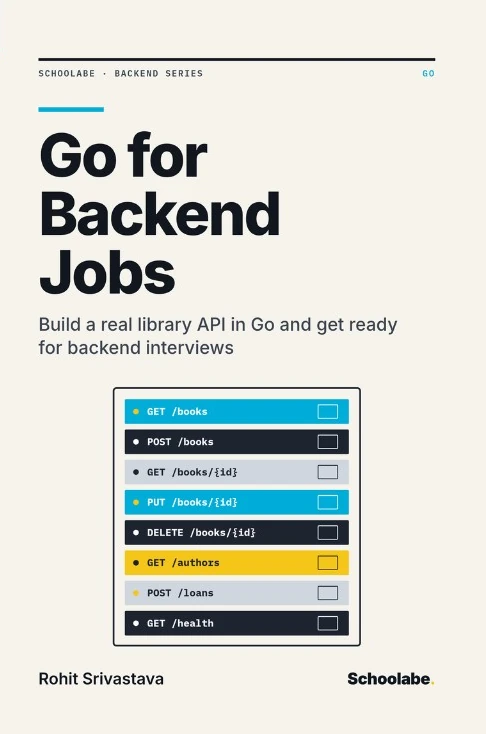
Routes in the finished service
Open reads are blue. Changes need a login token. Loans are yellow. Health is what a platform checks before it sends traffic.
- POST/signup
- POST/login
- GET/books
- GET/books/{id}
- POST/books
- PUT/books/{id}
- DELETE/books/{id}
- POST/books/{id}/loan
- DELETE/books/{id}/loan
- GET/me/loans
- GET/health
What's inside Go for Backend Jobs
Twenty chapters. Each one opens with a problem the library has, builds on the previous chapter, and closes with the questions interviewers ask plus five exercises.
01Your first Go program
Install Go, fix a program that will not compile, and meet Shelf, the library project every later chapter extends.
02Values, types and input
Learn variables, constants, zero values, and formatted output, then calculate a library fine from keyboard input.
03Functions, decisions, files and errors
Write your own functions, branch and loop, save work to a file, and treat errors as values you check.
04Packages and modules
Split the desk program into packages, choose which names other packages may use, and add a third-party module on purpose.
05Pointers
See why a copy is not an update, renew a loan through a pointer, and learn the two pointer mistakes interviews love.
06Structs and methods
Model a loan with structs, methods, and constructors. Embedding stands in for the inheritance other languages taught you.
07Saving the catalog as JSON
Turn the catalog into JSON and back, and fix the empty-braces bug that silently drops fields until you add struct tags.
08Interfaces, any and generics
Give two types one behavior. Learn when any is a last resort, and where generics remove duplication you would otherwise copy.
09Arrays, slices and maps
Hold Shelf’s catalog in slices and maps, and be ready to explain why an append did not show up in the caller.
10Functions as values
Pass functions, return them, and close over data. Recursion and variadic functions are here because interviewers ask.
11A batch job: the fine report
Read a file line by line, compute fines, write JSON, and swap the input source without rewriting the job.
12Doing several things at once
Run the report with goroutines, channels, and select. Turn on the race detector before you trust the result.
13The standard library toolkit
Use readers and writers, stream JSON, log with slog, store UTC and show IST, stop on Ctrl+C, and embed files in the binary.
14A REST API with a database
Serve books over HTTP from SQL with net/http. List, fetch, add, edit, and delete, and return status codes that mean what they say.
15Users, logins and loans
Hash passwords, hand out login tokens, and enforce who may edit a book. A member borrows a copy, and nobody else can until it comes back.
16Testing, benchmarks and profiling
Lock the fine rules, specified in paise, with table tests, httptest, fuzzing, benchmarks, and a pprof profile.
17Concurrency patterns for real jobs
Ship a worker pool, a rate limit, context timeouts, and a catalog-import pipeline. Close leaks and shut down cleanly.
18gRPC and protobuf
Give the catalog one owner and a protobuf contract, so a renamed column fails the build instead of the issue desk.
19Docker and deployment
Pack Shelf into an image of about 17 MB, read secrets from the environment, add health checks, and run on PostgreSQL as well as SQLite.
20A CI pipeline with GitHub Actions
Run tests, the race detector, and the image build on every push, on a clean machine, for each Go version you support.
Appendix ASolutions to the exercises
Every chapter ends with five exercises. The answers are here, and the longer ones are runnable programs in the repository.
Appendix BInterview prep
Sixty-five questions with model answers, in the order a Go round tends to move, plus how hiring usually runs at product companies and startups in India.
Appendix CGlossary
A short glossary for the terms the chapters use, so you can look up a word without leaving the argument.
Who this book is for
- College students who want a Go backend role and can already write a small program in any language.
- Working developers moving into Go who want one project they can talk through, from the schema to the shutdown.
- People who learn by building and who will type the examples instead of skimming them.
Schoolabe also teaches this path as Go: The Complete Course, with quizzes and a certificate. That is a separate product. This page is the book.
Skip it if
- You want an encyclopedia of every package in the standard library.
- You have never written a variable, a conditional, a loop, and a function.
- You want a Gin, Echo, or Fiber cookbook. The HTTP stack in this book is net/http.
- You want a data-structures workbook. Appendix B describes the DSA round. The chapters teach the Go round and the job.
Meet Rohit Srivastava
I started coding at 17 and taught myself, mostly by leaving too many tabs open and getting stuck at night with nobody to ask. Schoolabe came out of that. I had the idea in 2022 and shipped the version I wanted in 2024: a chapter you can finish in an evening, with practice beside it.
I wrote this book the same way. I have used Go on real work, including a video and recording feature that had to keep running. The advice on structure, errors, and concurrency is from that kind of code, from writing Go that had to work.
If you type the examples and do the exercises, you leave with Shelf, a library API you can explain, and 65 interview answers you have already said out loud.
Read the code before you buy
The book was published on 1 November 2026, so this page does not invent reader quotes. The work is public. Every chapter lives in its own folder, and the solutions to the longer exercises run.
The repository is github.com/rohit-schoolabe/go-for-backend-jobs. The module path in the book is the same.
- 20
- Chapters, each with interview questions and five exercises
- 65
- Model answers in Appendix B, meant to be spoken out loud
- 300+
- Tested code examples, with solutions in the back and on GitHub
Frequently asked questions
Who is Go for Backend Jobs for?
College students and working IT professionals who want a backend job in Go. You do not need to know Go. You do need basic programming in some language: a variable, an if, a loop, and a function, plus enough comfort with a terminal to run a command.
Do I need prior experience with Go?
No. Chapter 1 installs Go and starts with a program that will not compile. Pointers, slices, and memory are explained from scratch. You do not need C or a background in memory management.
How long does it take to read Go for Backend Jobs?
The Kindle edition is 433 pages, in 20 chapters plus three appendices. Each chapter is written so you can finish it in an evening. The five exercises at the end take longer than the reading, and they are the part worth doing.
What format is available?
Kindle, sold on Amazon for $9.99. You can read it in the Kindle app on a phone, tablet, or computer. It is in English. A paperback is not part of this listing.
Is there a refund policy?
Amazon sells this Kindle edition. If your order is eligible for a return, you request it from Amazon, from Your Orders or Manage Your Content and Devices. Schoolabe does not process Kindle refunds.
How is this different from other Go books?
You build one system, a library lending service called Shelf, from a console tool to a REST API, a gRPC catalog, a Docker image, and a CI pipeline. The HTTP stack is the standard library, net/http and database/sql. Every chapter ends with interview questions, and Appendix B collects 65 of them with model answers, including how a Go hiring loop usually runs in India.
Is the code free?
Yes. The examples are in a public GitHub repository, one folder per chapter, and the longer exercise solutions are runnable programs there. The book asks you to type the code first, and to open the repo when you have been stuck for more than twenty minutes.
Which database does the project use?
SQLite while you build and test, including a fresh in-memory database for tests. Later the same service runs on PostgreSQL, with migrations applied when it starts.
Start the library API today
Chapter 1 opens a terminal on a program that will not compile, and you fix it. From there Shelf grows into the service you can describe in a Go interview: the routes, the token, the loan rule, the test, the container, the pipeline.
Kindle edition · $9.99 · Download in the Kindle app · English