Edition 1 · PDF · 65 pages
System Design Cheat Sheet
A revision sheet for the high-level design round: 18 core topics, 8 classic designs worked in the same order, 15 architecture diagrams and a 109-term glossary. Small Python programs (a token bucket, consistent hashing, quorum, Snowflake-style IDs) were run on Python 3.13.5. Latency numbers are rules of thumb for the whiteboard, not benchmarks.
Price: ₹99
Apply coupon above, then buy — Razorpay opens after that
Pay, then download the PDF straight away. We also email you a copy. About 583 KB.
For your own study only. Please don't share the file. Refund policy
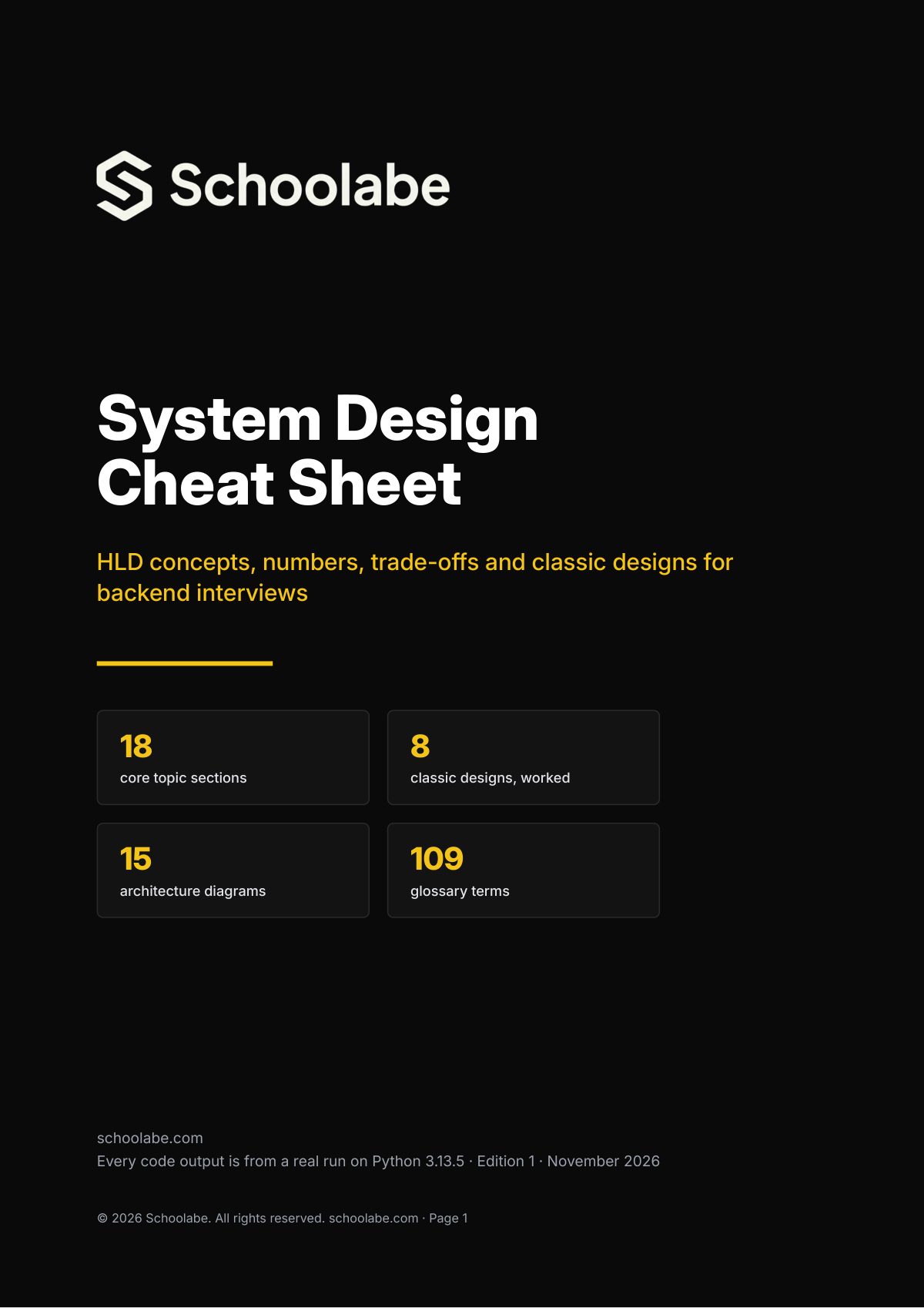
- 65 pages
- 18 core topics
- 8 classic designs
- 15 architecture diagrams
- 109 glossary terms
- Code run on Python 3.13.5
What's inside the System Design pack
The interview framework and estimation come first, because they decide the other 40 minutes. Eighteen topic sections follow. Each opens with the two or three sentences you would say first, then a table or diagram, the trade-offs, and the mistakes that show up in mocks. Eight classic designs use the same order: requirements, estimates, API, data model, diagram, decisions, bottlenecks and follow-ups.
| Section |
|---|
| The HLD interview framework |
| Back-of-envelope estimation |
| Availability, SLAs and the nines |
| Scaling and stateless services |
| Load balancers |
| Caching |
| CDN |
| Databases: SQL, NoSQL and indexes |
| Replication |
| Sharding and partitioning |
| CAP and PACELC |
| Consistency models |
| Message queues and streams |
| Rate limiting |
| Unique ID generation |
| Blob storage |
| Search |
| Observability |
| Design 1: URL shortener |
| Design 2: Chat and messaging |
| Design 3: News feed |
| Design 4: Rate limiter service |
| Design 5: Notification system |
| Design 6: File storage and sync |
| Design 7: Typeahead / search autocomplete |
| Design 8: Video streaming |
- 14 small Python programs show the mechanics: a token bucket, consistent hashing, quorum overlap, Snowflake-style IDs. Each was run on Python 3.13.5. Config, schemas and API sketches that need a real server are marked "example, not run".
- Latency and throughput figures are round numbers for a whiteboard. The point is the order of magnitude and showing your working.
- A one-page revision summary for the hour before the interview, and a glossary of 109 terms.
Sample pages
These are real pages from the Edition 1 PDF, shown so you can judge the layout and the writing. They are not a free chapter.
Who this pack is for
This sheet is for the high-level design round most backend interviews include, from about two years of experience upwards.
It is not a textbook and it is not the longer Schoolabe system-design course. It is the sheet you redraw from the night before: the framework, the numbers, and eight classic designs.
How to use the pack
- Start with the 45-minute framework. The first five minutes of questions decide the rest of the round.
- For each topic, cover the page and say the yellow-box answer, then redraw the diagram.
- For each classic design, walk requirements, estimates, API, data model and one bottleneck out loud before you read the follow-ups.
- Treat the latency table as orders of magnitude. Say that they are rounded, then show the multiplication.
Licence and refunds
The PDF is licensed to you, the person who bought it, for your own personal study only. You may read it on your own devices, print one copy for yourself, and copy the code or queries into your own practice files.
You may not share the file, or any part of it, with other people, for free or for money; resell it or include it in another product; upload it to a website, drive, group, channel or file-sharing service; or remove the Schoolabe name and copyright lines.
If a friend would find this useful, please send them to schoolabe.com instead of sending them the file.
Refunds follow Schoolabe's refund policy. That page says digital products that have been fully accessed or downloaded are generally non-refundable. Please read the policy before you buy.
Kafka, RabbitMQ, Redis, Cassandra, DynamoDB, PostgreSQL, Elasticsearch and Amazon S3 are named only as well-known tools. This sheet is not made or endorsed by their owners.
Questions about the System Design pack
What is in the System Design Cheat Sheet?
18 core topic sections, 8 classic designs worked in the same order, 15 architecture diagrams and a 109-term glossary. The PDF is 65 pages.
Are the numbers benchmarks?
No. Latencies and throughput are rounded rules of thumb for estimation on a whiteboard. The small Python programs (token bucket, consistent hashing, quorum, IDs) were run on Python 3.13.5. Their output is real. The capacity numbers are not a hardware benchmark.
How is this different from the Schoolabe system design course?
The course is the long lesson path. This is a 65-page revision sheet for the interview itself: what to say first, what to draw, and which trade-off to name.
How do I get the file, and can I print it?
After you pay, you download the PDF straight away, and we email you a copy. The licence allows one printed copy for your own use.
Can I share it with my classmates?
No. The licence is for the person who bought it. Please point classmates to schoolabe.com.
What is the refund policy?
See Schoolabe's refund policy. Digital products that have been fully accessed or downloaded are generally non-refundable under that policy.
Other packs
- Spring Boot Interview Pack — ready, Edition 1.
- SQL Interview Pack — ready, Edition 1.
- REST API Design Cheat Sheet — ready, Edition 1.
- See all packs.
Free practice stays at /interview-prep.