SYSTEM DESIGN:Lesson 2: Scaling the Data Layer

Mastering lesson 2: scaling the data layer concepts and implementation.

Practice this chapter

Read the theory, then wire up the architecture yourself. These labs match what you just learned.

Your app servers are fine. Your database is dying.

"We added six API servers behind a load balancer. Traffic was smooth. Then Postgres hit 98% CPU and every query started taking 3 seconds. The load balancer did its job. The database did not."

This is the most common scaling story in Indian tech. You horizontally scale the app tier during a sale or an IPL fantasy league launch — and discover the real bottleneck was hiding in the data layer all along.

App servers are stateless and cheap to replicate. Databases are stateful, expensive, and full of trade-offs. This chapter covers the four tools that actually fix data-layer bottlenecks: read replicas, sharding, caching, and CDN — plus the five-stage evolution diagram that shows how real systems grow.

If you have not read the scaling basics chapter yet, start there: Scaling Basics.

App servers happy, database not happy

App servers happy, database not happy

The load balancer did its job. Postgres did not get the memo.

Read replicas: split reads from writes

Most applications are read-heavy. A social feed might have a 100:1 read-to-write ratio. A product catalog might be 1000:1. Yet by default, every SELECT and every INSERT hits the same primary database.

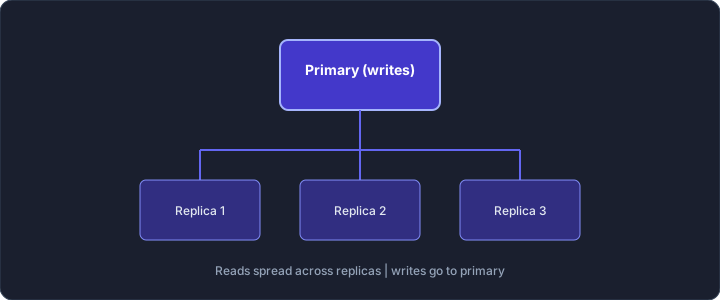
A read replica is a copy of your primary database that handles read queries only. Writes still go to the primary. Reads get distributed across replicas.

Read replicas distributing SELECT queries

Read replicas distributing SELECT queries

Write path:  App → Primary DB (INSERT, UPDATE, DELETE)
Read path:   App → Replica 1, Replica 2, Replica 3 (SELECT)
Sync:        Primary → async replication → Replicas
AspectPrimaryRead Replica
Handles writesYesNo (read-only)
Handles readsYesYes
Data freshnessAlways currentSlightly stale (replication lag)
Failover targetCan be promoted to primary
CostHigher (write-optimized)Lower (read-optimized)

Replication lag is the catch. A user posts a tweet, refreshes the page, and does not see it for 200ms because the replica has not caught up yet. For most products — Swiggy restaurant listings, Flipkart product pages, cricket scoreboards — eventual consistency on reads is perfectly acceptable.

For payments and account balances? You read from the primary. Know which queries need strong consistency and which can tolerate a few hundred milliseconds of lag.

Practical numbers:

  • One primary + 3 read replicas → roughly 4x read capacity
  • PostgreSQL async replication lag: typically 10–500ms under normal load
  • AWS RDS read replicas: add one in ~10 minutes, no code change if you use a read/write connection pooler

Sharding: when one database is not enough

Read replicas help when you have too many reads. Sharding helps when you have too much data or too many writes for a single machine to hold or process.

Sharding means splitting your data across multiple independent databases, each holding a subset of the total data. Each shard is a full database — schema, indexes, everything — just with fewer rows.

Without sharding:
  users table → 500 million rows → one Postgres instance

With sharding (by user_id % 4):
  Shard 0: user_id ending in 0,4,8... → 125M rows
  Shard 1: user_id ending in 1,5,9... → 125M rows
  Shard 2: user_id ending in 2,6...   → 125M rows
  Shard 3: user_id ending in 3,7...   → 125M rows

Choosing a shard key is the hardest part of sharding.

Shard key strategyExampleProsCons
Hash of user ID`user_id % num_shards`Even distributionCross-shard queries are painful
Geographic region`country_code`Data locality, complianceHot regions overload one shard
Tenant ID`org_id`Natural isolation for B2BLarge tenants create hot shards
Time-based`created_at` monthGood for logs/eventsRecent shard gets all writes

PhonePe does not shard UPI transactions by user name — they shard by user ID hash so each shard gets roughly equal write volume. A celebrity sending 10,000 payments in a minute would create a hot shard if you sharded by something correlated with activity.

When to shard vs when to wait:

  • Under 100 GB of data and moderate write volume → read replicas + better indexes first
  • Over 500 GB or write throughput exceeding single-node IOPS → start planning sharding
  • Cross-shard JOINs do not exist in production — design your queries around one shard key

Sharding is a last resort, not a first move. Every company that shards wishes they had designed for it earlier — but every company that shards too early wishes they had waited.

Redis cache-aside: stop hitting the database for hot data

Even with read replicas, some queries are so frequent that hitting any database at all is wasteful. "What is the current IPL points table?" does not need a Postgres query 50,000 times per second.

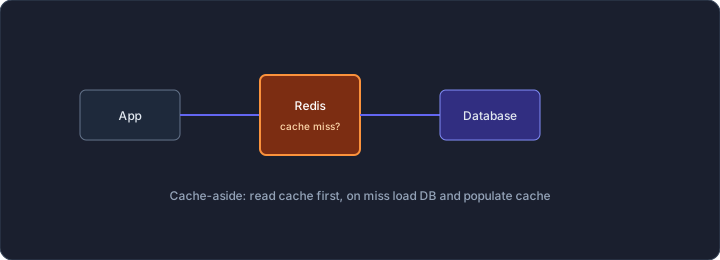
Cache-aside is the most common caching pattern in production:

Cache-aside pattern with Redis

Cache-aside pattern with Redis

READ:
  1. Check Redis for key "ipl:points_table"
  2. Cache HIT  → return cached data (1ms)
  3. Cache MISS → query Postgres → store in Redis with TTL → return data

WRITE:
  1. Write to Postgres (source of truth)
  2. Delete cache key "ipl:points_table" (invalidate)
  3. Next read will repopulate the cache
PatternWhen to useRisk
Cache-asideGeneral purpose, you control cache logicCache miss stampede on cold start
Write-throughCache and DB updated togetherWrite latency increases
Write-behindWrite to cache, async flush to DBData loss if cache crashes before flush
Read-throughCache layer handles DB fetch automaticallyLess control over query logic

What to cache (and what not to):

  • Cache: user profiles, product catalogs, leaderboards, config flags, session data
  • Do not cache: financial balances, real-time inventory counts, anything where stale data costs money

TTL (time-to-live) is your safety net.

Set a TTL even when you invalidate on write. If your invalidation logic has a bug, TTL ensures stale data expires eventually. A 5-minute TTL on a restaurant menu cache is fine. A 5-minute TTL on a wallet balance is not.

Redis numbers that matter in interviews:

  • Single Redis instance: ~100,000 ops/sec for simple GET/SET
  • Latency: sub-millisecond for in-memory reads
  • Memory: 1 GB Redis holds roughly 1 million small key-value pairs
  • Redis Cluster: shards data across nodes for horizontal cache scaling

CDN: serve static content from the edge

Your API servers should not be serving images, JavaScript bundles, and CSS files. That is what a CDN (Content Delivery Network) does.

A CDN caches static assets at edge locations close to users. A user in Chennai loading a Zomato restaurant photo hits a Chennai edge server — not your origin server in Mumbai.

Without CDN:
  User (Kolkata) → API server (Mumbai) → 80ms latency per image
  1M users × 10 images = 10M origin requests

With CDN (CloudFront / Cloudflare):
  User (Kolkata) → Edge (Kolkata) → 5ms latency per image
  Cache hit rate 95% → only 500K origin requests
Content typeCDN?Why
Product imagesYesLarge, rarely change, same for all users
JS/CSS bundlesYesVersioned by hash, cache forever
User-uploaded photosYesImmutable once uploaded
API responsesSometimesOnly if responses are identical across users
Personalized feedNoDifferent per user, low cache hit rate

Cloudflare has PoPs in Delhi, Mumbai, Chennai, and Bangalore. For an Indian user base, CDN is not optional — it is the difference between a 200ms page load and a 2-second one.

The five-stage evolution: how real systems grow

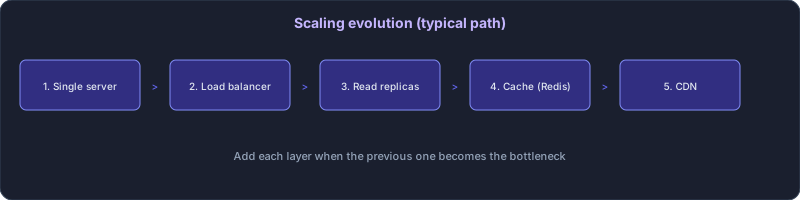
Every scaled system follows a similar path. This is not theory — it is the pattern behind every Indian unicorn from Flipkart to Zerodha.

Five-stage system evolution diagram

Five-stage system evolution diagram

Stage 1 — Single server:

One machine. App + DB + file storage. Works until ~1,000 DAU. Your college project lives here.

Stage 2 — App server + database server:

Split app and DB onto separate machines. DB gets dedicated CPU and RAM. Works until ~50,000 DAU.

Stage 3 — Load balancer + multiple app servers:

Horizontal scaling of the stateless app tier. Sessions move to Redis. Works until the database chokes. This is where most startups get stuck.

Stage 4 — Database scaling (read replicas + cache + CDN):

Read replicas for query load. Redis for hot data. CDN for static assets. This chapter. Works until ~10 million DAU for most products.

Stage 5 — Sharding + message queues + microservices:

Shard the database. Add Kafka for async processing. Split monolith into services. This is where engineering gets genuinely hard — and genuinely interesting.

StageDAU rangeKey additionComplexity
10 – 1KSingle serverTrivial
21K – 50KSeparate DB serverLow
350K – 500KLoad balancer + app poolMedium
4500K – 10MReplicas + cache + CDNMedium-high
510M+Sharding + async + servicesHigh

Do not skip stages. A team at Stage 2 that deploys Kubernetes and sharding because a senior engineer read a Netflix blog post will spend six months debugging distributed systems instead of shipping features.

Combining the tools: a worked example

Imagine you are designing the data layer for a cricket fantasy app during IPL season.

Traffic profile:

  • 50 lakh DAU during IPL
  • Peak: match days, 7 PM – 11 PM
  • 80% reads (leaderboards, player stats, team rosters)
  • 20% writes (team selection, point updates)

Architecture:

CDN → static assets (player photos, team logos)
Redis → leaderboards (sorted sets), live scores (TTL 10s), user sessions
Read replicas (×3) → player stats, historical match data, team rosters
Primary DB → team selections, point calculations, payments

Live scores get a 10-second Redis TTL because 10 seconds of stale score data is acceptable for a fantasy app. Wallet balances read from the primary because stale balance data is a lawsuit.

This is not over-engineering — it is matching each piece of data to the right storage tier based on access pattern and consistency requirements.

Common mistakes in data layer scaling

Mistake 1 — caching everything.

A 30% cache hit rate on personalized data means 70% of requests still hit the DB — plus you added Redis complexity. Cache what is actually hot and shared.

Mistake 2 — ignoring cache invalidation.

Phil Karlton was right: there are only two hard things in computer science — cache invalidation and naming things. Plan your invalidation strategy before you add Redis, not after users see stale data.

Mistake 3 — sharding too early.

A 10 GB database with 500 writes/sec does not need sharding. It needs better indexes and maybe a read replica. Sharding adds cross-shard query pain that lasts forever.

Mistake 4 — no monitoring on replication lag.

If your read replicas lag 30 seconds behind the primary during peak traffic, users see data from half a minute ago. Alert on replication lag > 1 second.

Mistake 5 — serving API responses from CDN without cache headers.

CDN only works if you set proper Cache-Control headers. Without them, every request is a cache miss and you are paying for a CDN that does nothing.

Practice with hands-on labs

These labs let you see data layer trade-offs in action:

  • Sharding Lab — pick a shard key, watch what happens with hot tenants
  • Consistency Lab — feel the difference between strong and eventual consistency

In the sharding lab, try sharding by user ID vs by region. The hot-shard problem becomes obvious in about 30 seconds.

What comes next: back-of-envelope estimation

You now know how to scale the data layer. The next skill is knowing how much to scale — how many servers, how much storage, how much bandwidth.

The next chapter teaches back-of-envelope estimation: powers of 2, latency numbers every engineer should know, and a worked example for designing a social feed.

Continue here: Back-of-Envelope Estimation.